

 Home
Home



R$200 billion infrastructure plan takes shape, SHODAILER flat semi-trailer truck beds become an accelerator for construction projects
setting off a nationwide infrastructure construction boom. Data from the Brazilian Infrastructure Association (ABIMEC) shows that the purchase volume of semi-trailers in the infrastructure field increased by 33% year-on-year in 2023, among which the demand growth rate for medium flatbed semi-Trailer Truck Beds 45%, mainly used to transport heavy construction materials such as steel, precast concrete components, and bridge components. It is expected that in 2025, more projects enter the construction peak period, the market demand for medium flatbed semi-trailer truck beds will exceed 300 units, becoming the core driving force for the of the semi-trailer market. The transportation of building materials in infrastructure projects has three characteristics: many types, complex sizes, and tight construction period, which poses extremely high for the adaptability, stability, and efficiency of the flatbed semi-trailer truck beds. In terms of transportation categories, building materials that need to be transported in infrastructure projects include steel pipes with a diameter of up to 1.5 meters, H-shaped steel with a length of over 10 meters, and precast concrete beams with a weight up to 30 tons, etc. Different types of building materials have different requirements for the size, load position, and fixing method of the truck bed; In terms of construction rhythm, the construction period of infrastructure projects is generally quite tight. For example, the Santos Port upgrade project requires the completion of the main project by the end of 202, and the transportation of building materials needs to be maintained uninterrupted for 24 hours, and the reliability of the truck bed directly affects the construction progress; In terms of road conditions, some infrastructure projects are located in suburbs or remote areas, with complex road conditions. The truck bed needs to have good driving stability to avoid the displacement or damage of building during transportation. Currently, the flatbed semi-trailer truck beds used in the Brazilian infrastructure field mainly have two problems: one is that the standardization degree is too, and the customization capability is insufficient. The mainstream size of the flatbed truck beds in the market is mostly 10 meters x 2.5 meters, which cannot be to oversized and extra-wide large building materials. For example, when transporting 12-meter H-shaped steel, additional extension devices need to be used, which not only transportation risks but also reduces transportation efficiency; The second is that the structural stability is insufficient, and the fixing device is simple. The traditional truck bed is only equipped with a simple wire rope fixing bolt, which is not strong enough to fix heavy construction materials during transportation. Building materials are prone to shift during transportation, resulting in a transportation accident rate of 12 times per 100 units per year; Third, the wear resistance is poor. The truck bed floor wears quickly when transporting sharp building materials such as steel, and the floor needs to be replaced once every 2 years, increasing maintenance costs.
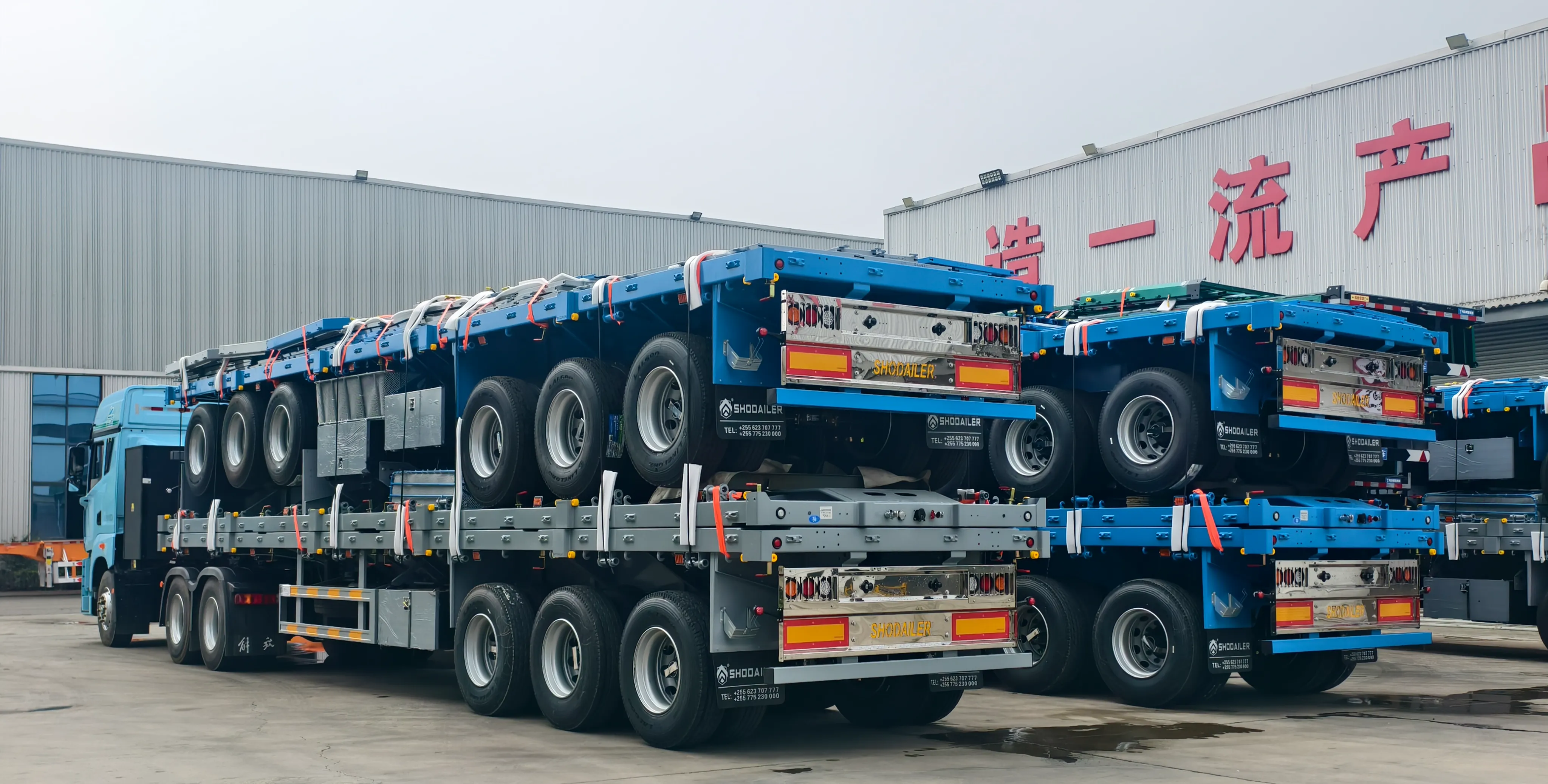
In response to the transportation needs of infrastructure projects, SHODAILER (Shoudai) launched SD-M300 medium flatbed semi-trailer truck bed, which has become the preferred equipment for infrastructure projects with its core advantages of "customization, high stability and high efficiency". In terms of customized design, this model provides flexible size customization services. The length can be adjusted between 8-12 meters, The width can be chosen between 2.5-3 meters, and the height can be adjusted according to the weight and center gravity of the building materials, perfectly meeting
the transportation needs of different types of building materials. For example, for the 12-meter long steel pipes to be transported in theo André port upgrade project, SHODAILER customizes the length of the truck bed to 13 meters, and sets up detachable guardrails at both ends prevent the steel pipes from slipping during transportation; for the 30-ton cement precast slab in the Brasilia International Airport renovation project, the spacing of the truck beds load-bearing beams is densified to 25cm, ensuring uniform load-bearing and avoiding local overloading that could cause the truck bed to deform. The structural of the truck bed is directly related to the safety of building material transportation. The SD-M300 type truck bed uses robotic welding technology, and the main welds of body adopt double-sided submerged arc welding technology, with a weld height of 10mm. X-ray non-destructive testing shows that there is no defect the weld, and the tensile strength reaches 500MPa, which is 30% higher than traditional manual welding. The main truck frame of the truck adopts a "U" section design, with a section height of 280mm, a web thickness of 14mm, and a flange thickness of 18. Combined with transverse reinforcement, it forms a solid frame structure. When carrying 30 tons of heavy building materials, the maximum deformation of the truck bed is only 1.5mm, which is far below the industry standard of 5mm, ensuring the structural stability during transportation. To solve the problem of fixing building materials, multiple groups of detachable anchor points are equipped on the surface of the truck bed, with a spacing of 50cm between each anchor point, and each anchor point can bear a weight of 5. The fixing position can be flexibly arranged according to the size and weight of the building materials, and combined with high-strength nylon strapping, it can effectively prevent the building from shifting during transportation.


